菜单
您的搜索结果

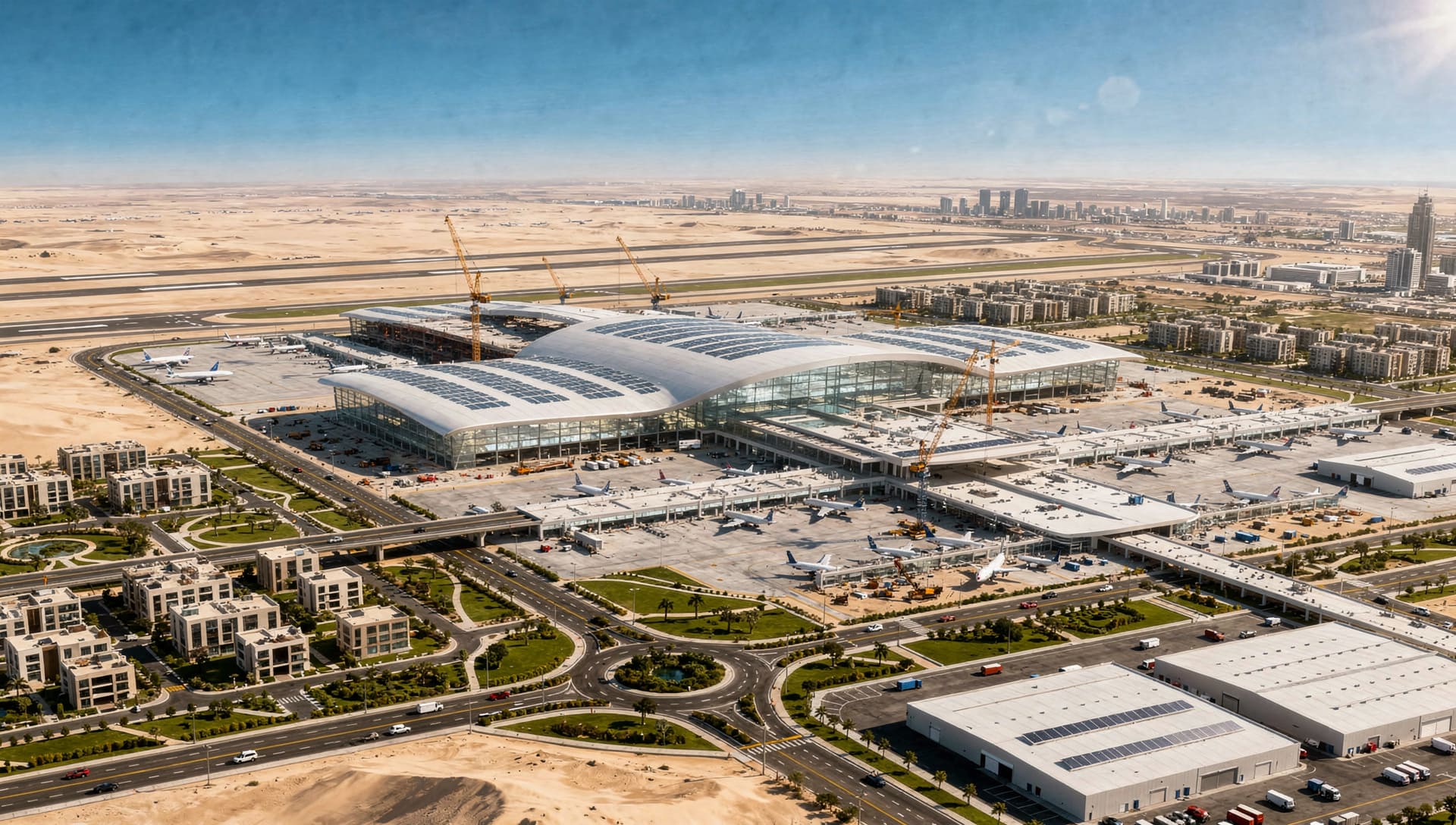
Over years of working in real estate, I have learned one rule: follow the infrastructure. The most reliable drivers of property prices in Dubai are not marketing campaigns or temporary trends, but large-scale government projects that change how people live and work . In 2026, nothing compares to the scale of the Al Maktoum International Airport expansion.

The numbers are striking. With $35 billion in investment, the airport will handle over 260 million passengers annually, making it five times larger than Dubai International Airport . It will feature five parallel runways, two passenger terminals, seven concourses, and more than 430 aircraft stands . Contracts worth AED 13 billion are already under execution, and Dubai plans to award another AED 55 billion in the coming months . The first phase is scheduled to begin operations in 2032 .

For property investors, however, this is not just an aviation story. It is about where people will live and work over the next decade.

The “Airport Effect” Is Already Happening

When an airport of this scale is built, a new city grows around it. People move closer to work, companies open offices, and schools, shops, and cafés follow. This is already happening in Dubai South — a vast 145-square-kilometre district that is developing around the airport .

Dubai Land Department data shows that transaction volumes in Dubai South reached AED 5.3 billion in Q1 2026 . Over the past six months, rental yields in the area have risen by 22.8%, with property values estimated at AED 211.4 million . Off-plan sales account for 86% of all transactions .

Why is this happening? Because the airport is not just a transport hub — it is a job creator. Projections suggest that up to one million residents and over 500,000 new jobs will emerge in the area once the airport reaches full capacity . Major airlines, logistics operators, and technology companies are already establishing offices in and around Dubai South. Where employment grows, housing demand follows.

The sweet spot for investment is now. Prices in Dubai South are significantly below the city average — roughly 60% lower than in Business Bay or Dubai Marina .

这对投资者意味着什么

For investors, Dubai South offers an opportunity to enter the market at an early stage. Over the past three years, property prices in Dubai South have risen by 30–50%. Studios that sold for AED 400,000 in 2022 now trade at AED 550,000–650,000 . Since 2024, prices have increased by 25%, while rental rates have grown by 20% .

Average rental yields in Dubai South stand at 6.8–8.5% . By comparison, yields in central Dubai typically do not exceed 5–6%. However, this higher yield is partly due to supply currently outpacing demand . Developers are actively building new projects, and landlords are setting competitive prices to attract tenants. As the airport expands and brings in more workers, this imbalance will narrow, and yields are expected to rise further.

What investors should keep in mind:

  • Long-term horizon. The main risk is timing: the airport will only reach full capacity by 2032 and beyond . Investing in Dubai South requires patience and a 5–10 year outlook.

  • Affordable entry prices. The average transaction price in Dubai South in 2026 is AED 891,000, making it the most affordable area we track .

  • Free zone benefits. Dubai South offers 100% foreign ownership, full exemption from corporate and personal income tax, and its own visa centre .

  • Flexible payment plans. Many developers offer post-handover payment plans over 2–3 years.

  • Golden Visa eligibility. Many projects in Dubai South are priced above the AED 2 million threshold, making them eligible for the 10-year UAE Golden Visa.

What This Means for Homebuyers

For homebuyers, Dubai South offers a rare opportunity in Dubai: spacious, well-planned homes at accessible prices.

What buyers should consider:

  • Price per square foot in Dubai South (AED 1,200–1,800) is 40–55% lower than in Business Bay and 60–65% lower than in Downtown Dubai . Studios start from AED 490,000, and 1-bedroom apartments from AED 920,000.

  • The district is being designed as a self-contained city , with schools, parks, shops, and offices built alongside homes . You won’t have to wait years for infrastructure to arrive.

  • A wide range of housing options — from studios and apartments to townhouses and waterfront villas.

  • The area is still developing , so not all amenities are available yet. If you need an established community from day one, Dubai South may feel too much like a construction site .

  • Car dependency. The area is not yet well connected to the city centre by public transport, so a car is essential.

What This Means for Renters

For renters, Dubai South offers the chance to rent modern accommodation at lower prices than in central areas, while living close to work.

What renters should know:

  • Average annual rents in Dubai South:

    • Studio: AED 42,000 – 45,000

    • 1-bedroom: AED 62,000 – 65,000

    • 2-bedroom: AED 85,000 – 88,000

  • Rent increases are regulated by Dubai’s standard rules. Even with high demand, landlords cannot raise rents beyond the official index.

  • Demand will grow. As the airport creates new jobs, more professionals will move to the area, increasing competition for good apartments.

  • If you work in aviation, logistics, or near Expo City, living in Dubai South is convenient — your commute will be 10–15 minutes instead of an hour from the city centre.

  • Entertainment options are still limited , but the situation is changing quickly with new cafés, shops, and public spaces opening regularly.

A New Economy, A New City

Dubai South is being designed as a self-sufficient city, not just a dormitory suburb:

  • Free zone advantages : 100% foreign ownership, full tax exemption, and an on-site visa authority.

  • Smart urban planning : sustainable technologies, walkable neighbourhoods, schools, offices, parks, and shops within easy reach.

  • Multi-modal transport : connectivity to Etihad Rail, new metro lines, and autonomous vehicles.

  • Cultural infrastructure : an opera house, exhibition halls, and a performing arts academy.

Major developers have already announced projects: premium residential complexes from Damac, waterfront homes at Southbay Lagoon, a golf course community from Emaar, and the transformation of Expo City into a modern urban centre . Over 1,000 units in South Bay and South Living are scheduled for handover by the end of 2026 .

我最后的建议

The expansion of Al Maktoum International Airport is not just a transport project. It is a structural shift in how Dubai will function over the next two decades. Areas once seen as “peripheral” are becoming the centre of a new economic ecosystem.

If you are a long-term investor , this is one of the most significant opportunities in Dubai’s market today. The airport is set to open in 2032, but the property market is already responding. The window for entering at current prices is closing. Most activity is currently focused on the off-plan market, where you can get in at an early stage .

If you are buying a home , Dubai South offers something rare in Dubai: thoughtfully planned neighbourhoods, affordable prices, and real growth potential. Schools, parks, and shops are being built alongside homes, not years later.

If you are a renter , Dubai South is a chance to live in a modern area close to work at prices lower than in the city centre. Just be prepared for the fact that the area is still developing.

The smartest investors I know are not waiting for the airport to open. They are buying now, while the infrastructure is visible but the premium is not yet fully priced in.

If you are considering investing near the new Al Maktoum International Airport or would like a personalised recommendation based on your budget and goals, I am happy to help.


Liliia Ibragimova,Alira 房地产创始人

预约免费咨询

📞 +971 58 833 7903
在社交网络上分享文章:

    头部

    头按钮

    头链接

请通过WhatsApp联系我们,我们在线!

比较房源